
Multi-species distribution modeling using deep CNNs and satellite embeddings
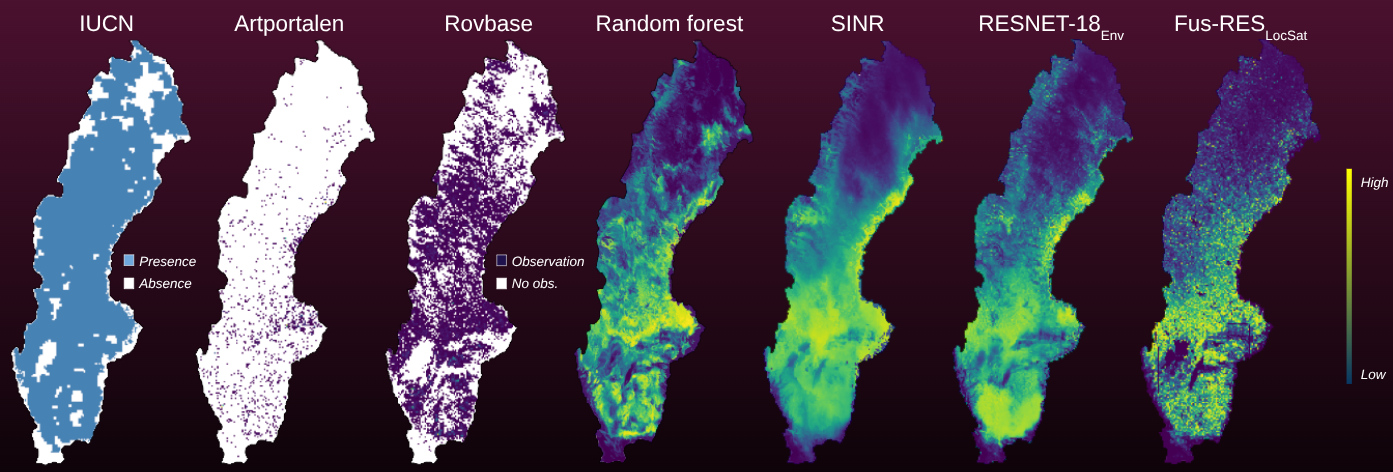
Traditional Species Distribution Models (SDMs) rely on coarse bioclimatic variables, struggling to capture localized ecological niches, habitat fragmentation, and multi-species interactions. This paper presents a high-resolution, multi-species deep learning framework modeling 34 terrestrial mammals across Sweden using opportunistic crowd-sourced data. We benchmark a deep convolutional neural network architecture (ResNet-18) against a spatial MLP (SINR) and Random Forest baselines. Crucially, integrating AlphaEarth Foundations (AEF) 64-dimensional satellite embeddings yields a performance improvement over traditional climate variables, pushing mean Average Precision (mAP) from 0.924 to 0.972. To counteract spatial observation biases inherent in presence-only records, we introduce a custom distance-density pseudo-absence generation mechanism. Models are evaluated across three distinct proxies: a held-out test split, an independent apex carnivore dataset (Rovbase), and expert range maps (IUCN Red List). Our results demonstrate that high-resolution satellite embeddings are essential for capturing fine-grained local landscape variations, accounting for human impacts, and maintaining robust performance under significant spatial distribution shifts.
Markus Blixt, Carl Klang, Olof Mogren
PDF Fulltext
DOI:
bibtex.